Showing posts with label iconography. Show all posts

21 September 2006

eikongraphia

Michielangelo recently has re-launched his blog as Eikongraphia, an updated version of his ongoing investigations into the role of iconography in architecture. I've definitely enjoyed Michiel van Raaij's thoughts and speculations as to how a building's iconography relates to its form and meaning -- his commentary is hard to categorize but easy to appreciate. The basic premise consists of short vignettes that take on a building strictly on iconographic terms (some of my favorites include the Penis and Vagina entries), thereby attempting to reconcile traditional formal concerns with a building's actual lasting effect -- essentially, how it is consumed by its observers. Read van Raaij's "Narrative" for a more detailed description of his methodology. While I do have some concerns with reading a building simply as an object for consumption, I am intrigued by the notion of "iconicity" (a term I presume coined by van Raaij? I've never come across it before) as an architectural quality to be pursued, or even perfected. It potentially offers a new, post-Venturi Scott-Brown way of understanding architectural form, and I'm curious to see how it plays out -- and if the politics of form/iconography will come into play.

link: Eikongraphia

14 August 2006

blog radar :: 14 august

Just catching up the highlights of my Google Reader feeds these past few weeks:

  • BLDGBLOG. Geoff Manaugh has kept up a constant stream of noteworthy posts, including the Kazys Varnelis interview noted previously, speculation on "landscape theology" (whatever that is) in an interview with Erik Davis, and a feature on inflatable/biodegradable toilets for refugee camps by Studio Cycle.
  • Subtopia. Another blog with consistently high-quality posts, ranging from border station design ( "Welcome to America") to refugee urbanism in Israel and Lebanon ("War as Vacation" ) to a review of an exhibition on the city of Tijuana ("Strange New World" ). The recurring theme of border urbanism reminds me of an article in the most recent issue of Log (#7) by Marie Aquilino ("Free Zone: A Conversation with Amos Gitai"), which addresses Gitai's film "Free Zone" and the the strange phenomena of free-trade cities, particularly Zarqa City in Jordan, a hub with links to the borders with Iraq, Syria, and Saudi Arabia.
  • The fallacy of New Urbanism. From Planetizen, Leonardo Vazquez has written an article ("Urban Fables: The Role Of Storytelling And Imagery In Successful Planning Movements") on how the New Urbanist movement has ap propriated religious strategies of allegory and myth to further their cause. Vazquez compares the New Urbanists to the conservative property rights movement (in terms of their similar appeals to " people's hopes, fears and beliefs") -- while this is certainly right on the mark, I would go further and say that New Urbanism not only takes hints from property rights activists, but in fact operates in an almost identitcal manner as the broader political and religious right wing. Readers of this blog have heard me rant previously on the convergence of New Urbanist and conservative political ambitions in the wake of Hurricane Katrina. I must say that there is a certain satisfaction in seeing other writers not only comment on the ultimate fiction of New Urbanism -- its false nostalgia for a past that never existed in the first place, as I like to say -- but also relate it to the fictions (and, dare I say, untruths) that underlie the contemporary right-wing agenda in this country.
  • Niemeyer still going strong. From Tropolism, some cool photos of Oscar Niemeyer's latest project, a theater in Ibirapuera Park, São Paulo. Looks like the old guy still has it...
  • Keller Easterling talks. An Archinect feature: Mason White interviews architect, theorist, and Yale professor Keller Easterling about her writings and practice. From having seeing Easterling's lectures and having her on a couple reviews while at school, I've always been intrigued by her fascination with such strange things as third-world golf courses, cruise ships, and industrial tomato farms. I've been meaning for a while to check out her latest book Enduring Innocence -- check out the interview for a taste.
  • Why Sylvia Sucks. From Michielangelo, a humorous yet enchantingly critical review of a lecture by Sylvia Lavin. I won't go into the details, but topics include iconography, dildos, and pet rocks. Worth checking out.

12 December 2005

jencks on icons


ARCHINECT HAS A FEATURED INTERVIEW with Charles Jencks discussing his new book The Iconic Building and his recent discussion/debate with Peter Eisenman at Columbia GSAPP. Jencks claims a certain criticality with respect to the propagation of iconic architecture in recent years, yet he nevertheless chooses to define these icons as

I also find his lamentation that we live in an age of "weak belief" quite disturbing and, dare I say, out of touch. I certainly understand his nostalgia for metanarratives of democracy and progress, but I would hardly say that we live in a world in which belief fails to "produce things of depth." Be careful what you wish for, Charlie.

I do like his reference to Potsdamer Platz, however, as "inflationary architecture."

link: Being Iconic on Archinect

that's a wrap: ICA in progress


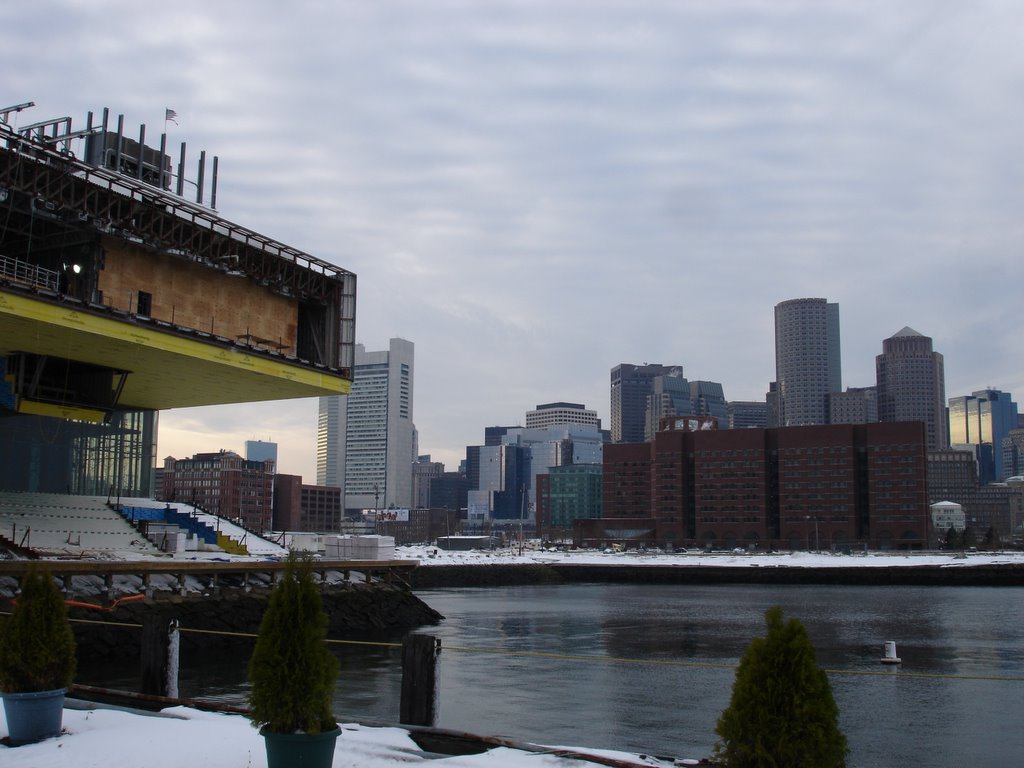
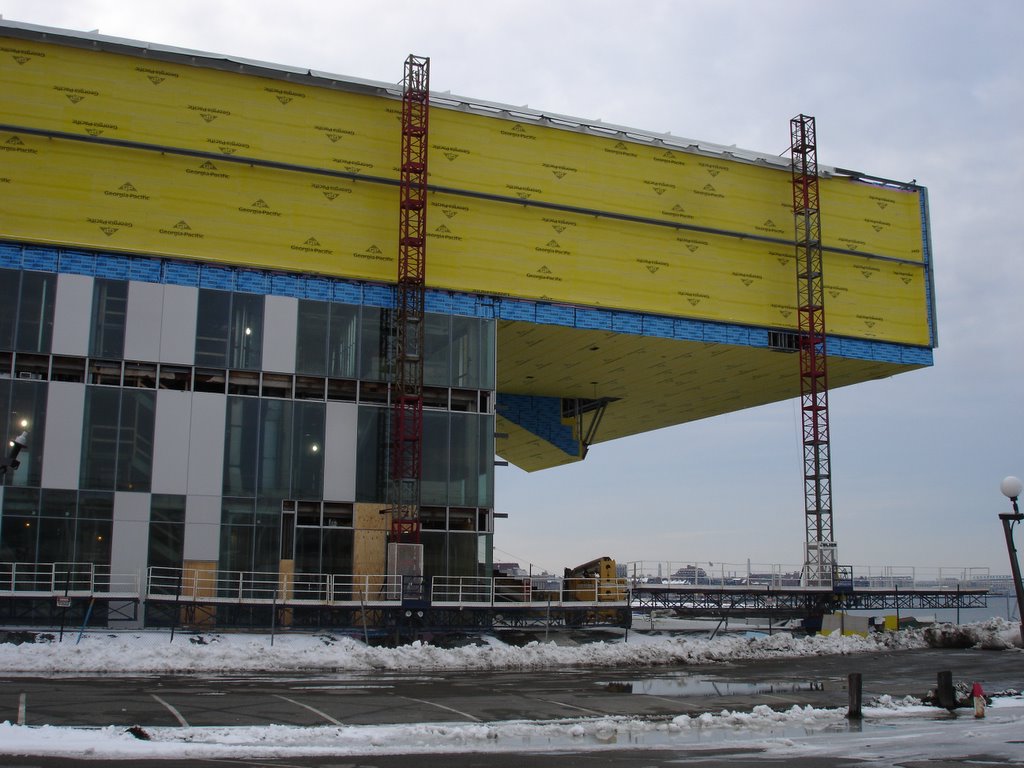
PASSED THROUGH BOSTON THIS WEEKEND and drove by Diller Scofidio + Renfro's new Institute for Contemporary Art. Quite a cantilever, I must say.

One thing that is very evident in the construction photos is the artificiality of this whole "ribbon" or "wrapper" business that dominates not only DS+R's work but also that of many other contemporary practitioners. You can see where the veneer will be applied (along the blue "slab edge" surface and back around the center portion of the building to the exterior stair) to create the image of a continuous ribbon that perhaps, supposedly, creates some sort of programmatic organizational logic. My question is: what is this imagesince it is merely an image getting us?

Maybe a random thought, you say but very relevant to today's practice. Some have said that contemporary architecture is now in the midst of a new "international style" defined loosely by an affinity for smoothness, continuous surfaces, ribbons, wrappers, etc.... I ask again, though, what is the point, especially if this continuity often remains simply a veneer, an afterthought, a myth? There must be some potential meaning in the formal devices at play, yes?