I woke up this morning to read
this article in the
Times about a tanker named Probo Koala that recently dumped hundreds of tons of toxic waste in the suburbs of Abidjan, the capital of Ivory Coast. The tanker, leased by Trafigura, one of those vague multi-national corporations dealing with oil, minerals, and various front companies that disguise its questionable business practices, apparently had been turned away from various ports throughout Europe due to the extreme toxicity of its cargo. Trafigura was unwilling to pay the roughly $300,000 necessary to adequately dispose of the waste, and the company instead opted to dump it in Ivory Coast, where costs are much lower and fewer questions are asked. Now the Ivory Coast is crippled with a massive public health crisis (85,000 sick) and faced with growing political instability as the population demands some explanation for their misfortune (the prime minister has already resigned). Needless to say, this is already a volatile corner of Africa, where it often takes much less than a large-scale environmental and health crisis to spark conflict and unrest.
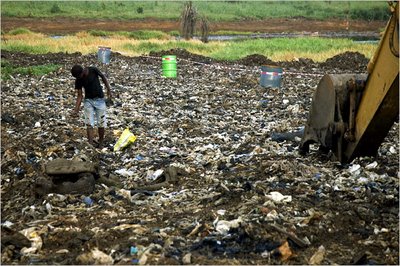
The story -- reported fantastically, by the way, by
Times reporters Polgreen and Simons -- reminds me of Don DeLillo's book
Underworld, his 1997 masterpiece that chronicles the Cold War through, among other things, the lens of the global waste industry. DeLillo's book is haunted by a recurring, almost sublime image of a super-tanker that perpetually travels from one global port to another, endlessly but unsuccessfully seeking to unload its cargo of the world's most toxic waste. The diagram of the recent travels of the Probo Koala contains no such sublime quality, but it eerily recalls the darkness of DeLillo's fiction, with the ship's trail literally rendering the devastating, grotesque dark side of globalization.
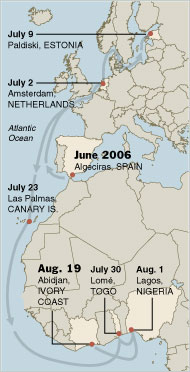
Both the provenance of the waste and the ownership of the tanker itself are unclear. With a sentence that could be lifted directly from DeLillo, the article matter-of-factly explains the waste's origins: "It came from a Greek-owned tanker flying a Panamanian flag and leased by the London branch of a Swiss trading corporation whose fiscal headquarters are in the Netherlands."
What?Clearly something is wrong with the paradigm of globalization as it exists today. Maybe people will start understanding this before it gets too late? Maybe the devastation in Ivory Coast will somehow have a positive long-term effect as it galvanizes global powers to right these terrible wrongs and mitigate the destructive tendencies of global capitalism?
link:
"Global Sludge Ends in Tragedy for Ivory Coast" by Lydia Polgreen and Marlise Simons, in the
New York Times


 Posts
Posts


