Showing posts with label postmodernism. Show all posts

20 November 2008

derivative of what?

Finally. John Lanchester, of whom I must admit I have never before heard, has a stunning piece buried in the back of Nov. 10 New Yorker on the credit crisis as it relates the broader cultural paradigms of modernism and postmodernism. Although I've appreciated the commentary of Krugman (who just today so succinctly declared: "This is an economic emergency"), Reich, and others these past few months, this is really the first piece of critical analysis that I've read that situates the credit crisis within a larger cultural and philosophical context.

Lanchester's article, which uses the format of a book review of recent books on the credit crunch as an excuse to analyze its cultural/theoretical dimension, is as revelatory as it is simple. Of course derivatives, credit-default swaps, and all those other bizarre financial instruments are nothing more than financial incarnations of the classic late twentieth-century disjunction between the signifier and the signified. And of course the root of the crisis lies in the escalation of this disjunction to the point where the signifier no longer retains any connection whatsoever to the original signified. Lanchester's piece echoes critic/philosopher/writer Mark C. Taylor (see his book Confidence Games from a few years back) in this idea of how money has essentially become nothing more than a floating signifier. All value is relative—or derivative, if you will. It's all a house of mirrors. Lanchester's key line:

It seems wholly contrary to common sense that the market for products that derive from real things should be unimaginably vaster than the market for things themselves.
Now forgive me for my sudden, euphoric lapse into the language of post-structuralism and deconstruction; nobody should have to parse such nonsense. But in all seriousness, most people have no idea what the hell is going on with this credit crisis, and hopefully Lanchester's reading of the situation can help to encourage a broader understanding. It sure did for me.

link: "Melting Into Air" by John Lanchestor, in the New Yorker

19 November 2007

so long, new frontier


Via Design Observer: the destruction of the New Frontier Hotel in Las Vegas last week. I (perhaps perversely) find it amazing how the demolition industry in Vegas has become a spectacle, an ecstatic ritual set to the tune of Tchaikovsky. I particularly love how the Wynn towers in the background, presiding with complicit and knowing consent...

26 January 2007

russian airports, cured meat, and postmodernism

I'm a bit behind on the posting (as usual) - but here's a quick note on the Economist fantastic year-end issue that by now is already a month old. The fabulously British newspaper uses this annual issue as an excuse to write about odd and offbeat topics, while at the same time using these unlikely news items as critiques of or commentaries on the world at large. And it's all infused, of course, with that characteristic Economist wit that we know and love. It's always something to look forward to, and this year's holiday dispatch is certainly no disappointment. A few favorites (if the links require subscription - I apologize):

"Russian airports: Kama Sutra and feral cats." A fascinating tour of the airports of the former Soviet Union, this article reads like some sort of perverse travelogue. It's brilliant. The story begins with Moscow's Sheremetyevo airport and goes on to explore the nation's other major airports, all of which seem to be characterized primarily by a permanent state of chaos. The insanity, however, nonetheless inspires within the writer a small measure of awe and - dare i say - admiration; the Russian airport becomes a metaphor for the Russian nation itself: a chaotic state of (heretofore) untapped potential. Some choice moments:

[image: Wikipedia]

On Sheremetyevo:

Sheremetyevo is war. The international terminal was built for the 1980 Olympics, to showcase the Soviet Union's modernity; now it recalls the old regime's everyday callousness (the anarchic domestic terminal is even worse). On a bad day, the queue at passport control stretches almost to the runway.

The Sheremetyevo virgin soon meets the various species of Moscow queue-jumper: the brazen hoodlum; the incremental babushka; the queue-surfing clans who relocate in groups when one of their number reaches the front. The immigration officer—usually sporting peroxide blond hair, six-inch heels and an abbreviated skirt—offers an early insight into Russian notions of customer service. Reflecting the country's neo-imperialist confidence, the immigration form was for most of this year available only in Russian (“distributed free”, it says, in case anyone is tempted to pay).

On Mineralnye Vody (in the north Caucasus):

Mineralnye Vody airport is a lower circle of hell.... It is weirdly cold inside. Feral cats have been sighted. The floor has not been cleaned since perestroika; the toilets are hauntingly squalid. On the wall there are arrival and departure boards that no longer work, and a big, proud map of the Soviet Union.
On Irkutsk (in eastern Siberia):

Planes descend into the city's airport over identikit Soviet apartment blocks and rickety Siberian dachas. The current arrivals terminal is a hut on the apron of the tarmac. Passengers wait in the street until the baggage-handlers feel inclined to pass their bags through a hole in the hut's wall. The bags then circulate on a terrifying metal device apparently borrowed from a medieval torture chamber. The nearby departure terminal is chaos, though by ascending an obscure staircase passengers can find an interesting photographic display on “minerals of eastern Siberia”.
On a side note: some quick Google Image searching found a photo of the (in)famous Domestic terminal at Sheremetyevo -- from the article, it sounds like a nightmare on the inside, but it sure looks pretty cool.

[image: link]


"Cured meat: Feet in the trough." A survey of the long tradition of smoking and curing pork that begins with Cato the Elder and ends with the new start-up of Paul Bertolli, formerly of the famous Chez Panisse in Berkeley. Vegetarians should refrain from this one.

"Shopping and philosophy: Postmodernism is the new black." This article is a surprisingly accessible and lucid account of how the "postmodern" critiques of consumer capitalism espoused by writers like Lyotard, Foucault, and Derrida have been assimilated into and coopted by the very Establishment they sought to undermine. I'm continually fascinated by how so-called "oppositional" strategies and techniques are redeployed by those in control to undermine that opposition (and vice-versa: how reactionary strategies can be directed into progressive tactics... but that's another story). An obvious example of this is the amazing ability of the Bush administration to repackage conservative policies under the mantle of supposedly progressive aims like education and environmental concerns -- often branding them under intentional misnomers like "No Child Left Behind," "Healthy Forests," or "Clean Skies."
The Economist article, however, focuses less on politics and more on how consumer marketing has latched onto postmodern theories of difference, fragmentation, and extreme individualism as a means to reinvent marketing practices. Perhaps Apple is the most successful at this strategy -- telling its consumers to "Think Different," as if each individual iPod with its mass-customized engraving, color choice, and playlist preserves some sort of sense of individuality. Regardless - an interesting read, and it makes me wonder more and more where now (with regard to postmodernism) if a newspaper like the Economist, capitalist champion extraordinaire, is writing about postmodern strategies of mass marketing. If capitalism has absorbed and repackaged its own critique, then what's next?

23 August 2006

SANAA in Toledo

[all images: six million dollar man's flickr site]

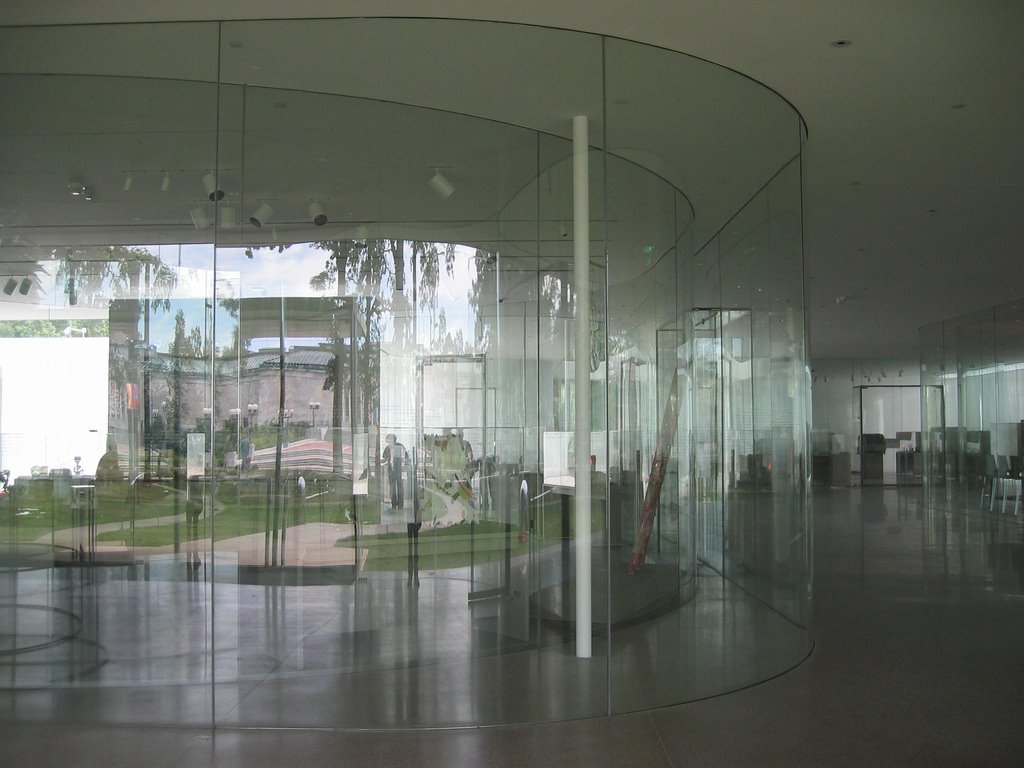
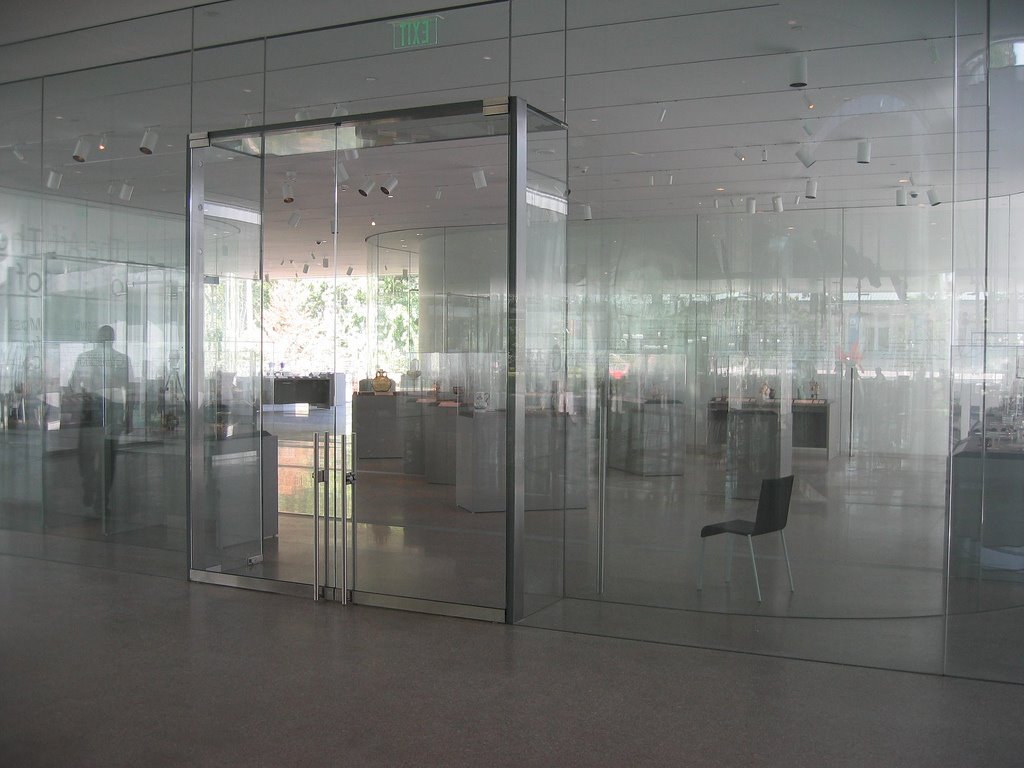
Check out Christopher Hawthorne's review of the brand new Glass Pavilion at the Toledo Museum of Arts, designed by Kazuyo Sejima and Ryue Nishizawa.

Their joint venture, SANAA, is known mostly for their highly refined, exquisitely detailed mastery of glass, which often produces other-wordly effects of transparency, layering, and pure visual fascination. I've never had the opportunity to see Sejima and Nishizawa's work in person -- although I eagerly await their forthcoming New Museum on the Bowery in New York -- but from what I can tell, there's something going on in their architecture that really distinguishes them from the rest of the contemporary field. I'm not really sure what it is yet. Something to do with an understated play with reflection, light, and visual relationships. But not in the modernist mode -- rather, SANAA operate with a completely postmodern sensibility. And I'm not talking about the disorienting, blingy, hall-of-mirrors postmodernism espoused by people like John Portman and theorized by people like Fredric Jameson, or the ridiculous Wallpaper magazine, empty neo-modernism that Hawthorne accurately criticizes. This work is much more hands-off and open to interpretation, and there is always much more to their projects than meets the eye. As you can tell, I'm having trouble verbalizing the appeal of their work -- as is Hawthorne, who suggests a contrast between SANAA's architecture and the bland minimalism that we find everywhere but, like me, fails to explain exactly why they're different. That's the point though. It's the irreducibility, the confusion, and the refusal of this work to be pigeonholed that makes it superb.

05 August 2006

more on sam jacob + VSBA

Following up on an earlier post: I just came across another piece by Sam Jacob (of England's FAT), which somehow I missed during previous visits to his fantastic site. As I've written about previously, Jacob again embraces Venturi and Scott Brown, he suggesting an atypical (yet nonetheless insightful) interpretation of their career. Although he confesses a fondness for their built work (including the Acadia Summer Arts Program, pictured above), the true root of his admiration (and mine, for that matter) seems to be on a larger ideological and polemical level. It becomes less about that problematic label of "postmodernism" and more about a deeper modus operandi of "Pop": not the standard definition of Pop that we all learned about in Art History class, but rather (in Jacobs' words) "a kind of socially engaged Pop -- a Pop that isn't only fast, fun and ironic, but political and moral as well."

Why, you ask, does the progressive reactionary keep babbling on about Venturi, Scott Brown, and all their followers? Well, for one, it's all about the attitude. The mentality. For me, there's something inherently political -- both progressive and reactionary -- in the act of embracing what the establishment deems garish. Challenging the status quo of contemporary architecture, regardless of formal or stylistic preference, is always a positive thing. Or maybe my affinity for the work of VSBA and FAT stems from a more personal anxiety surrounding my own architecture and (in comparison) its muted blandness. Whatever the case: what it comes down to, and what Jacobs is so right about, is that we can all learn a lot from the ugly and the ordinary. After all, we're all postmodernists, and it's time we embraced it.

26 June 2006

portmania

Aric Chen resurfaces (after his departure from the Architect's Newspaper gossip column) in today's Times with a piece on John Portman and his many super-hotels. I must confess a certain awe/admiration for Portman's spaces -- on more than one occasion, I have wandered around the Marriot Marquis in Times Square just for the hell of it, watching those retro-round elevator pods shoot up into the impossible atrium/void. In this respect, I definitely sympathize with Koolhaas's simultaneous contempt and fascination with Portman's hotels -- and I think his suggestion in S,M,L,XL of the isomorphism between Portman's voided hotels and the decentered nature of Atlanta offers quite a strong critique of both. (Yet I should note that I think the true source of Koolhaas's admiration of Portman is not the architecture, but rather the megolomania.) Of course, Koolhaas was not the first to appropriate Portman as a symptom of broader cultural developments; Fredric Jameson's seminal 1984 article "Postmodernism, or The Cultural Logic of Late Capitalism" introduced Portman's Bonaventure Hotel in L.A. as the archetypal "postmodern hyperspace," with its "milling confusion" of the bewildering atrium, elevators, escalators, and aimless wanderers. Chen hints at the Jameson text when he mentions the labyrinthine, disorienting nature of Portman's spaces, but mostly his commentary presents a watered-down interpretation of Portman's architecture, with lines like the following: " Their cylindrical tinted-glass towers sparkled atop concrete podiums, while inside, ficus-filled Xanadus of flying walkways, spiraling stairs and cantilevered terraces were waiting to be discovered — an ideal habitat for the modern nomad in search of a well-garnished cocktail." Surely there's more to modern nomadism, and more at stake in Portman's hotels, then the quest for booze? Too bad Chen didn't delve deeper... but then again, it's just a Travel section article.

link: "The Kubla Khan of Hotels" by Aric Chen, in the New York Times

23 January 2006

FAT's postmodernism


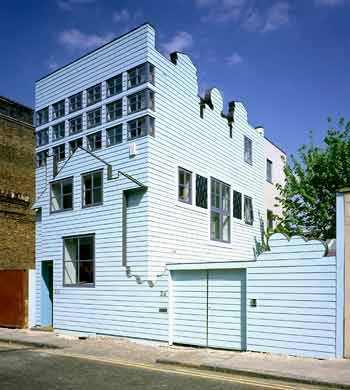
I'VE BECOME FASCINATED LATELY with the work of the London office FAT (Fashion, Architecture, Taste), which recently has been commented upon here, here, and here. While at first glance, the architecture seems (at best) a weak update of earlier, perhaps more genuine attempts at architectural postmodernism, I think there may be something deeper going on here. After spending a short time on FAT's website (which, I'm sure not coincidentally, recalls that of Venturi Scott Brown), my initial disgust slowly is replaced by a more intellectual -- dare I say political? -- curiosity. Sure, it's easy to write these guys off (like I normally would) as typical anything-goes postmodernists, completely devoid of taste, ethics, conscience, or any other such redeeming quality. But this time I hesitate. Why?

It's simple: although on aesthetic grounds much of their work renders me mildly nauseous, FAT is nonetheless exonerated in my eyes by their relentless and engaging polemic. A refusal to accept the status quo -- in their case, the persistent dominance of English modernism as the benchmark for acceptable taste -- imbues FAT's project with something greater than mere "attitude." I identify with and commend the eagerness to reinvent architecture, how it is represented, and what is expected of it.

I also am intrigued (and even at times amused) by FAT's written polemic. Their website is full of mini-manifestos, many of which again bring to mind the legacy of Venturi Scott Brown. "Maybe its time to decriminalise decoration and arrange an amnesty on ornament," FAT asks us in Everything Counts (In Large Amounts), a treatise on the evolution of architecture in the age of electronic communication.

FAT member Sam Jacob, in a piece on his own website Strange Harvest, caught my attention with a subtle yet definite elaboration on the central premise of Venturi + Scott Brown's 1972 masterpiece Learning from Las Vegas. Check it out:

The Pop Vernacular is a both a graveyard for the old and the superseded and the spawning ground of unexpected futures. A cornucopia of architectural salvage. The Pop Vernacular draws on all of time and space. And despite its familiarity, it glows with optimism and freshness. Far from the end of history, it is the well spring of the imminent future.
For those of you who don't remember your postmodernism, VSB begin their manifesto with the assertion that "Learning from the existing landscape is a way of being revolutionary for an architect." Yet I would argue that they never really followed through with proving Pop's revolutionary potential (at least in any political sense beyond the superficial and symbolic). Although VSB's embrace of the formal language of Pop was a valiant polemical move, especially at the time, their approach ultimately is misguided as it fails to offer a way out of the black hole of consumer capitalism. Call me crazy, but it seems like here, Mr. Jacob is suggesting a potentially progressive -- if still totally vague -- role for the Pop Vernacular. Is he hinting at an instrumentalization of Pop that maybe goes beyond that of Venturi and Scott Brown? Or will he end up at the same claustrophobic dead end of the windowless, decorated-shed interior of some casino on the Strip? Can't wait to see.

I'd be interested to see if anyone has any other links/commentary/criticism with regard to FAT and their work.

link: FAT
link: Sam Jacob's Strange Harvest
link: Hugh Pearman's FAT is a postmodernist issue: British pranksters get serious.