08 November 2006

all politics is [not] local
[photo: New York Times]

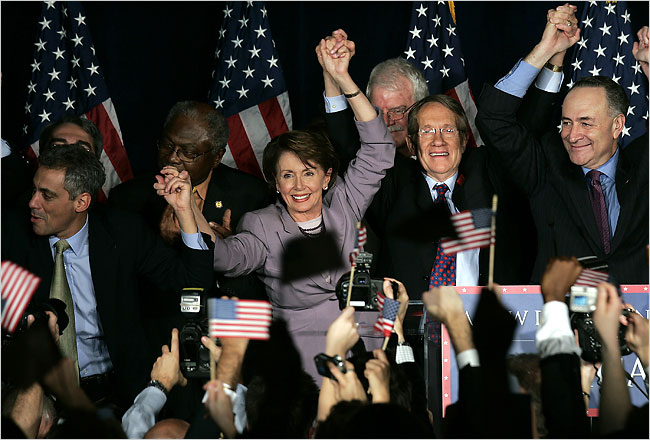
WELL, WELL, WELL. It's been quite a day, hasn't it? Leading up to Nov. 7, there had been buzz of an electoral "wave" -- akin to the Republican sweep of 1994 -- but did you really think it could happen? Madam Speaker Pelosi? Senate Majority Leader Reid?

The election will be picked over endlessly by pundits in the days and weeks to come -- and most of the analysis no doubt will revolve around the drama and intrigue of the oh-so-close races that are responsible for the new Democratic Congress. [And what drama! McCaskill surging at 1am ... Tester clinching it this morning ... and Webb, incredible Webb, defeating George Allen by the slimmest of margins.]

For me, however, this election goes beyond the drama and excitement, and it really becomes about a much larger shift in the political landscape of this country. Legendary Speaker Tip O'Neill is often (and wrongly, some say) credited with coining the phrase "all politics is local," a political worldview that stresses the importance for elected representatives to respect and tend to their immediate base in order to preserve their positions. And indeed, in O'Neill's day, if you were a congressman, you really did have to cultivate that local base in order to stay in power. Local issues ultimately trumped national or global issues; in many ways, the widespread Democratic neglect of their base helped accelerate the Republican takeover in 1994.

Today is a different situation. In contrast to the hyper-localism of the days of Tip O'Neill, it seems to me that national and international politics have collapsed into the local, and our elected representatives are now held accountable for events and policies of global scope. Sure, there are always broader national trends that affect local elections, but one can't help but notice how a global paradigm of a "smaller world" resulting from the constant flow of information has begun to affect the democratic process itself. For me, this election has always been about accountability -- about sending a message that the status quo is not acceptable, and that change is necessary. Suddenly we find that a congressman from Indiana or Kentucky can be held accountable for national issues and international policies; democracy is becoming redefined as accountability becomes globalized.

So congratulations, Dems. Enjoy this moment; you've certainly earned it. But also be wary. An increasingly empowered electorate will make 2008 that much harder.


06 November 2006

vote.

Tomorrow's a huge day. Be a part of it. Democracy is not a spectator sport.

PR

16 October 2006

40 bond update

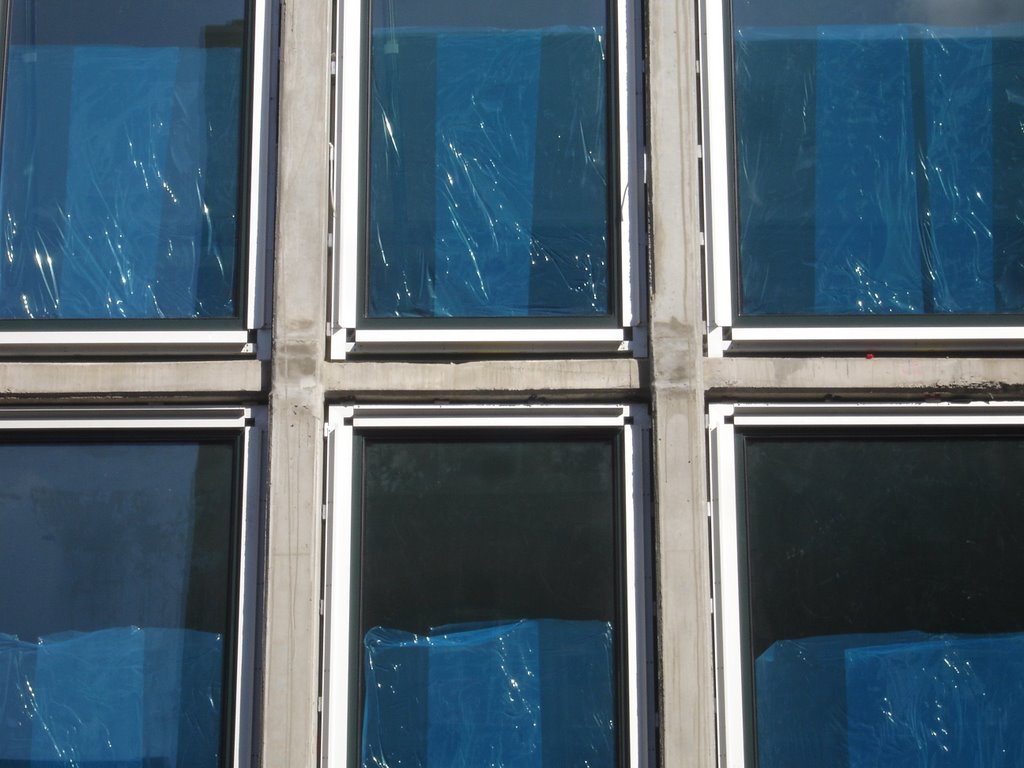
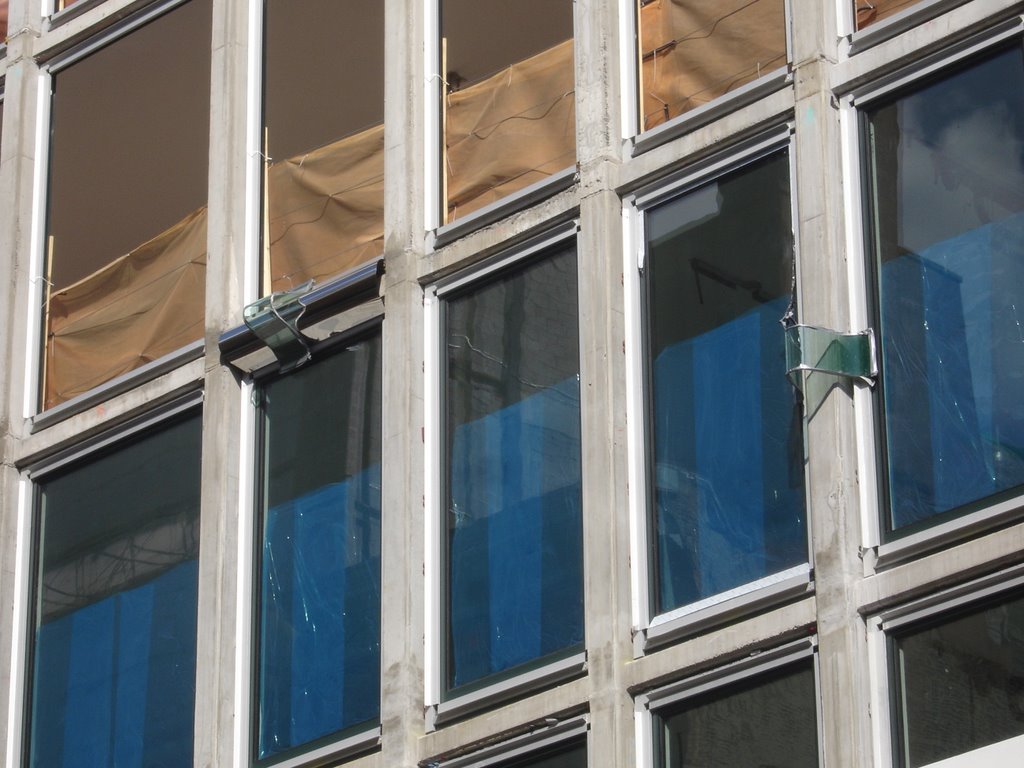
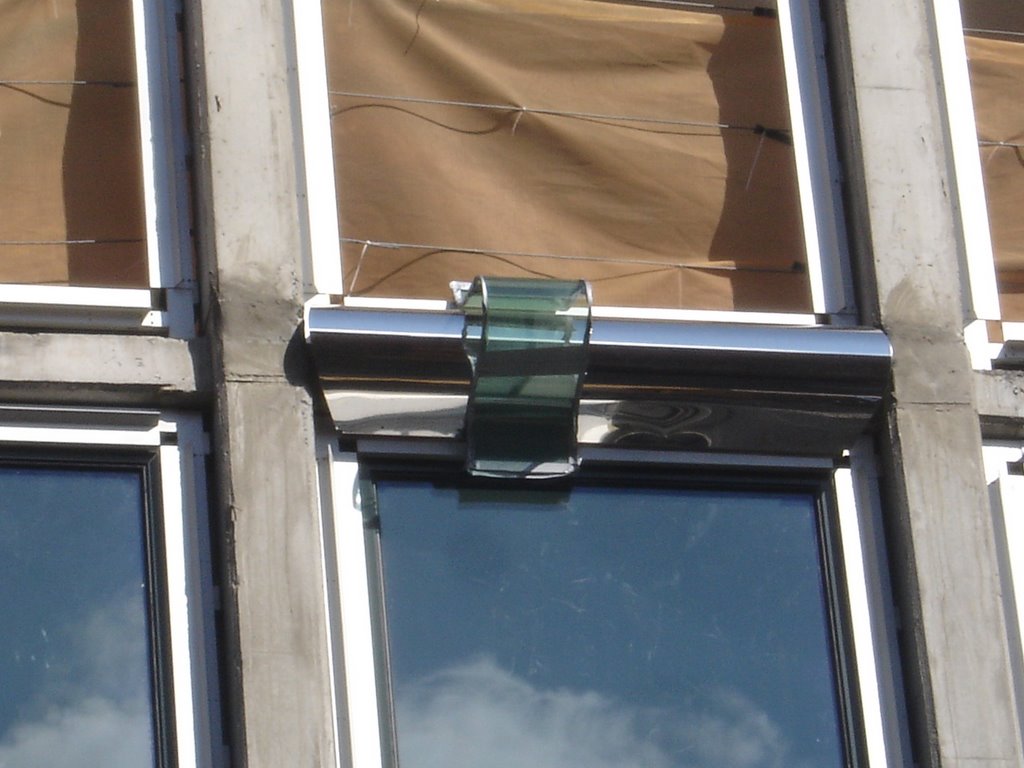
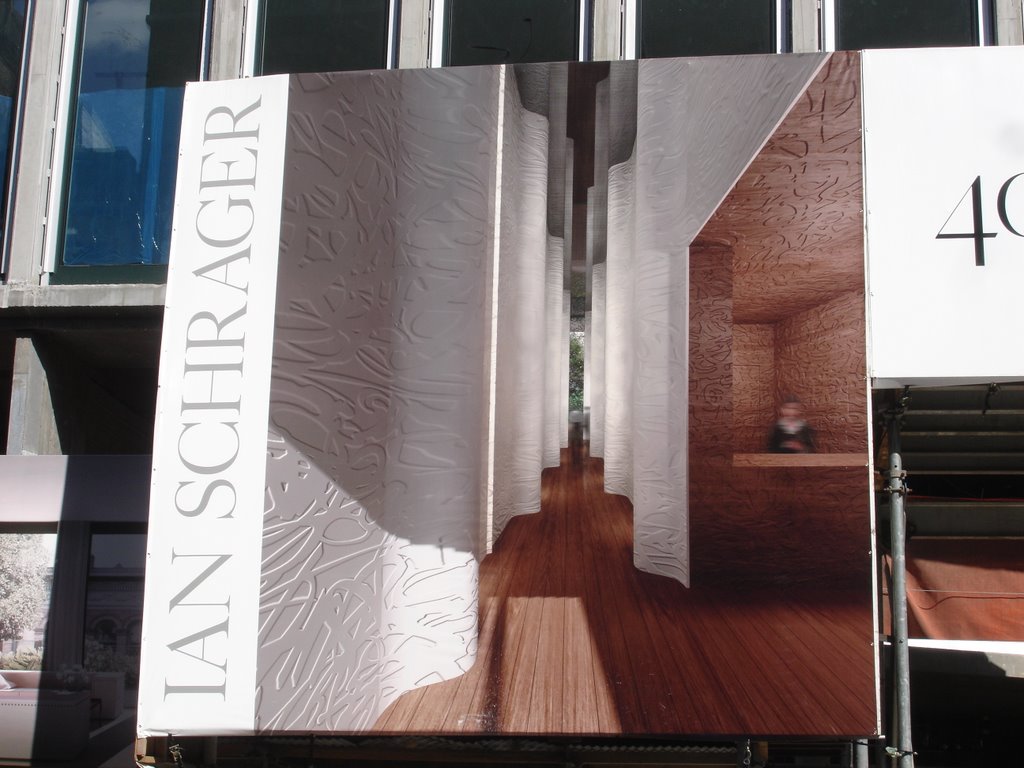
I got a chance over the weekend to snap a few photos of the rapidly-progressing 40 Bond project, an Ian Schrager residential development designed by those Swiss hot-shot duo Herzog and de Meuron. Although I do enjoy much of Herzog and de Meuron's formal research, material treatments, and patterning techniques, I tend to regard their buildings critically and almost categorically as nothing but over-dressed boxes. 40 Bond fits perfectly into this genre: the billboards claim that "Herzog and de Meuron radically reinvent the cast-iron building," when in fact the building is nothing other than a "cast-concrete" building, soon to be covered in fancy glass tubing. Material substitution does not suffice for reinvention. And furthermore, by ignorantly invoking the imagery of New York's cast-iron architectural legacy for such a blatant cause of gentrification, H&dM neglects the typology's rich social history. The same can be said for the bling-bling, one-liner appropriation of graffiti imagery for the street-level facade. In the end, 40 Bond is nothing but another developer project, albeit one with a larger budget for ornamentation. And surely the ornamentation will be stunning and the details expertly executed -- but isn't it time for our most famous architects to take on more critical architectural pursuits?


frederic chaubin: socialist architectural eccentricities


[image: "Druzhba Holiday Center Hall" (Yalta, Ukraine, 1984)© Frederic Chaubin]

Via BLDGBLOG and PingMag : a short piece with some fantastic images of architectural relics of the Soviet regimes in countries like Georgia, Belarus, and Ukraine. This understudied genre is a continuing obsession of mine - and although I'm most familiar with and fond of the architecture of the Western Balkans (former Yugoslavia), these particular buildings are quite stunning. The images leave me wanting more. Send any tips, links, references, etc. my way...

link: Frederic Chaubin: Soviet SF Style from PingMag

03 October 2006

"a dark tale of globalization"

[images: New York Times]

I woke up this morning to read this article in the Times about a tanker named Probo Koala that recently dumped hundreds of tons of toxic waste in the suburbs of Abidjan, the capital of Ivory Coast. The tanker, leased by Trafigura, one of those vague multi-national corporations dealing with oil, minerals, and various front companies that disguise its questionable business practices, apparently had been turned away from various ports throughout Europe due to the extreme toxicity of its cargo. Trafigura was unwilling to pay the roughly $300,000 necessary to adequately dispose of the waste, and the company instead opted to dump it in Ivory Coast, where costs are much lower and fewer questions are asked. Now the Ivory Coast is crippled with a massive public health crisis (85,000 sick) and faced with growing political instability as the population demands some explanation for their misfortune (the prime minister has already resigned). Needless to say, this is already a volatile corner of Africa, where it often takes much less than a large-scale environmental and health crisis to spark conflict and unrest.

The story -- reported fantastically, by the way, by Times reporters Polgreen and Simons -- reminds me of Don DeLillo's book Underworld, his 1997 masterpiece that chronicles the Cold War through, among other things, the lens of the global waste industry. DeLillo's book is haunted by a recurring, almost sublime image of a super-tanker that perpetually travels from one global port to another, endlessly but unsuccessfully seeking to unload its cargo of the world's most toxic waste. The diagram of the recent travels of the Probo Koala contains no such sublime quality, but it eerily recalls the darkness of DeLillo's fiction, with the ship's trail literally rendering the devastating, grotesque dark side of globalization.


Both the provenance of the waste and the ownership of the tanker itself are unclear. With a sentence that could be lifted directly from DeLillo, the article matter-of-factly explains the waste's origins: "It came from a Greek-owned tanker flying a Panamanian flag and leased by the London branch of a Swiss trading corporation whose fiscal headquarters are in the Netherlands." What?

Clearly something is wrong with the paradigm of globalization as it exists today. Maybe people will start understanding this before it gets too late? Maybe the devastation in Ivory Coast will somehow have a positive long-term effect as it galvanizes global powers to right these terrible wrongs and mitigate the destructive tendencies of global capitalism?

link: "Global Sludge Ends in Tragedy for Ivory Coast" by Lydia Polgreen and Marlise Simons, in the New York Times

01 October 2006

on the fifty state strategy

We interrupt the standard stream of architectural commentary for one of our periodic political posts. I know some readers may not be interested, but you'll just have to deal: the next five weeks will play a crucial role as this country decides whether or not to renew a commitment to the stale status quo that has been in place for the past six years. The midterm elections are on November 7, and they represent a chance for the Democrats to take back at least one house of Congress, thereby sending a clear message that enough is enough, that the present conduct of government is no longer acceptable. Much talk has been made of the similarities between this year's political climate and that of 1994, when the Gingrich-led Republican insurgency captured both the House and the Senate. Notwithstanding these seemingly favorable prospects for Democrats, there are nonetheless important differences between the Republicans of 1994 and the Democrats of 2006, and a Democratic takeover is far from certain.
I just read Matt Bai's article in today's New York Times Magazine, which delves into the trials and tribulations of Howard Dean and his efforts to rebuild the Democratic Party. Read it. Let me know what you think. It seems obvious to me that Dean's fifty state strategy is the only way to reinvent the Democratic Party as an effective and potentially victorious political force. It's a long-term vision that is not incompatible with electoral success this November, contrary to the claims of Dean's critics within the party. Its strength lies in its rejection of the red state / blue state dichotomy and the appropriation of time-tested Republican techniques of widespread, local organization. It makes sense to learn from those who win elections, and after 2000, 2002, and 2004, it's time for a change. Sure, Dean may be a "flawed visionary" (Bai's words), but he's a visionary nonetheless.

link: "The Inside Agitator" by Matt Bai, in the New York Times Magazine


21 September 2006

eikongraphia

Michielangelo recently has re-launched his blog as Eikongraphia, an updated version of his ongoing investigations into the role of iconography in architecture. I've definitely enjoyed Michiel van Raaij's thoughts and speculations as to how a building's iconography relates to its form and meaning -- his commentary is hard to categorize but easy to appreciate. The basic premise consists of short vignettes that take on a building strictly on iconographic terms (some of my favorites include the Penis and Vagina entries), thereby attempting to reconcile traditional formal concerns with a building's actual lasting effect -- essentially, how it is consumed by its observers. Read van Raaij's "Narrative" for a more detailed description of his methodology. While I do have some concerns with reading a building simply as an object for consumption, I am intrigued by the notion of "iconicity" (a term I presume coined by van Raaij? I've never come across it before) as an architectural quality to be pursued, or even perfected. It potentially offers a new, post-Venturi Scott-Brown way of understanding architectural form, and I'm curious to see how it plays out -- and if the politics of form/iconography will come into play.

link: Eikongraphia

20 September 2006

artkrush 41 / boeri

Check out the new issue of Artkrush (their third architecture issue) - there's an interesting interview with Stefano Boeri (of Boeri Studio, Multiplicity, and editor of Domus) in which the Italian architect talks about some of his myriad research endeavors throughout the globe. I've always had a few misgivings about Boeri's methodology -- which essentially consists of obsessive and exhaustive documentation of super-local conditions -- as it walks the fine line between studied observation and sensationalist exploitation (dare I say exoticization). While I know that Boeri's intentions are of course not to exoticize or exploit, and I appreciate his rigorous explorations of emergent urban conditions, there is always a certain ambiguity in my mind about who is actually benefitting or profiting from the research.

Regardless -- the interview is pretty interesting. In relation to my own concerns, I found this excerpt on Boeri's intentions particularly compelling:

I believe that the act of observing, describing, and interpreting the built environment helps us understand the community we inhabit. And I believe that the landscape — the territory continually defined by our movements, reinvented by our desires, punctuated by what we build — is an excellent metaphor for our society. The local is a treasure chest rich in details and clues that tell us about the forces that permeate our daily lives, forces that at times are manifest in the space that surrounds us, perhaps just for a few instants, like footsteps in the snow. Architecture's political dimension is not to be found in the labels we attach to our projects, nor in our magniloquent political declarations; rather, it lies in the production of useful and critical knowledge about the world that surrounds us — knowledge that is useful because it is critical.
I also am intrigued by Boeri's interpretation of borders and boundaries as potential sites for intervention and action: "I try to conceive of boundaries as the sensors of contemporary world dynamics — dynamic 'devices,' which vibrate with the energy and resistance that drive current history." Since it seems that the world we live in is increasingly defined by different degrees of boundaries and "devices" of separation, it makes sense to pursue architectural strategies that subvert and redirect these divisive phenomena towards a more productive purpose. The question is: how?

14 September 2006

complexity and contradiction, revisited

[all photos: Venturi Scott-Brown Associates]

I had a chance to swing by Columbia last night for a presentation by Bob Venturi, followed by a discussion between the architect and GSAPP dean Mark Wigley. You are probably rolling your eyes, since I seem to always have Venturi and his wife/partner Denise Scott-Brown on my mind. But indulge me once again -- there were some interesting moments worth sharing.

The event was loosely structured as a celebration of the 40-year anniversary of the publication of Venturi's seminal debut book, Complexity and Contradiction in Architecture (1966). For those who haven't read this -- you should. It is absolutely one of the most essential texts (along with Venturi's 1972 follow-up, Learning from Las Vegas, co-authored with Denise Scott-Brown and Steven Izenour) for understanding the predicaments facing contemporary architecture. After a stirring introduction by Lee Bollinger, Columbia's president and Venturi's old client back at Michigan, Venturi began with some brief reflections on both the book's inception and critical reception. Reiterating comments he has made over the years in various articles and symposia, he insisted that interpretations of the book or of him as being anti-modern or postmodern are completely misguided. This has always been pretty clear to me -- the book, while celebrating the immense stylistic diversity of historical architecture, by no means prescribes a specific style. Rather, it advocates an approach of celebratory, almost hedonistic, eclecticism -- or what Venturi likes to refer to as mannerism. While much of VSB's architectural production has involved neoclassical elements or historical references, the style itself is arbitrary and almost besides the point. [And furthermore, in line with Venturi's claim last night that Complexity and Contradiction ultimately affirmed a functionalist approach to architecture, almost all of the VSB work follows a strict functionalist paradigm of boxy, ultra-efficient floorplans that often divorce service spaces from served spaces. A reference to Kahn, no doubt, to whom Venturi also paid tribute tonight. The functionalist imperative appears again and plays a huge role in Learning from Las Vegas.] Anyway, the point is that it's understandable why historicist postmodern architects latched on to Complexity and Contradiction as justification for their stylistic carelessness, but the sweet irony is that, in true form, they completely missed the intricacy of Venturi's argument.


The discussion consisted mostly of Wigley's characteristic wizardry with words that seemed to completely baffle poor old Bob. He essentially asked the same question -- why did you write Complexity and Contradiction? -- a dozen times in a dozen different ways. The hope was to elicit some sort of polemical commitment to manifesto-writing and the activist potential of theorizing (to which I fully subscribe), but Venturi simply refused to cede Wigley any ground, insisting that the book grew out of his lectures for a theory class he was teaching at Princeton in the early 60's. I wondered if Wigley was actually talking less about Venturi and more about himself: if he was trying to posit a projective role for the writer in order to justify his own career as a non-practicing architect. Maybe that's getting a little too Wigley-psychoanalytic. Who knows. Anyway, the banter continued at length until Denise Scott-Brown, who, like the rest of us, could not take any more of the labyrinthine inquisition, finally decided to tell him what he wanted to hear. "Bob writes to figure out what he thinks," she said, explaining how the writing indeed came to inform their practice. Whether she was actually sincere, or whether she was just doing us all the favor of neutralizing the debate, I'll never know. But her brief words made me want more. Even though the event was nominally in honor of Complexity and Contradiction, which Venturi wrote solo, I realized (yet again) that Venturi without Scott-Brown is really only half the story.


The most interesting part of the evening was Venturi's emphatic characterization of his own writing as purely pragmatic and realist, as opposed to purely idealistic. In other words, he claims the basis of his learning and his analysis is always the existing conditions, the ordinary, the "real" world as it is, and that conclusions are never drawn from any preconceived ideologies. Hence the "Learning from..." technique that proved so crucial in the later collaboration with Scott-Brown and Izenour.

Clearly this enchantment with the messy realities, chaos, multiplicities, and vibrancies of everyday life is what really defines the Venturi Scott-Brown legacy. It certainly explains why I identify so strongly with their work. And seen in that light, it becomes evident why a school like Columbia would kick off its heavy-hitter lecture series with an event honoring good old Bob Venturi, who is still considered a postmodern pariah by many orthodox practitioners of architecture. It's definitely time, as architects as diverse as Koolhaas and FAT have come to realize, to reconsider the Venturis and their influence over the past forty years. Not only are they "back," as I've said - but maybe they never actually left.

12 September 2006

five years after

[image: New York Times]

AS I SAT TODAY in my office, a block from Ground Zero, with the constant drone of bagpipes echoing up from the memorial ceremonies below, I couldn't help but reflect on the terror attacks that so changed the world five years ago. Yet perhaps due to the weather -- so, so eerily reminiscent of that crisp fall morning in 2001 -- I began to ponder that maybe things haven't really changed that much. I started to think about accountability, and about how everything that has spun out of control since the Trade Center fell -- Afghanistan, Iraq, Abu Ghraib, Guantanamo, countless terror attacks around the globe -- can in a certain sense be traced back to a crisis of accountability. And then of course I saw this image of the ground zero site as it exists tonight, still a gaping hole in the city, such a fitting metaphor for the failures and missed opportunities of these last five years.

I often write of the architect's ethical imperative to design responsibly in a world of increasing irresponsibility. The stakes are even higher now, believe it or not, than they were five years ago, and it's pretty clear that architecture is ever more implicated. If we assume that every building imagines a better city (and, by extension, that every city imagines a better world), then what does the above image have to say about our future? Do we accept this status quo? Or do we insist it changes?

On that note (sort of), for those of you in Arizona, Delaware, Washington DC, Maryland, Minnesota, New Hampshire, New York, Rhode Island, Vermont, or Wisconsin, don't forget that tomorrow (Sept. 12) is primary day. It's important. As a New Yorker, I'll be using the primary as an opportunity to make a statement, to demand a measure of accountability that seems to have vanished. Of course there is no chance of unseating the all-powerful Senator Clinton -- and, indeed, I'm not so sure that our long-term interests would be best served by replacing her with Jonathan Tasini, her under-qualified, anti-war challenger for the Democratic nomination. But a vote for Tasini offers a chance -- if admittedly futile -- to make a simple statement in protest of a legislator who made the wrong choice in supporting a very wrong war. [The previous two sentences reveal the constant debate between my inner pragmatist and inner idealist. I apologize.] A wise man once told me that democracy is not a spectator sport; voting is not a privelege, but a responsibility. It is our duty as citizens to make known such grievances to our elected representatives, and I can't imagine a better way for Mrs. Clinton to understand the gravity of her misguided support of Bush's war than to see her supposed invincibility diminish by a few percentage points in tomorrow's primary. See you at the polls!

PR


07 September 2006

ground zero update: fosters, rogers, maki join the mix

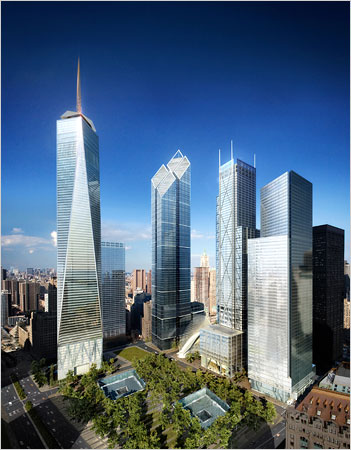
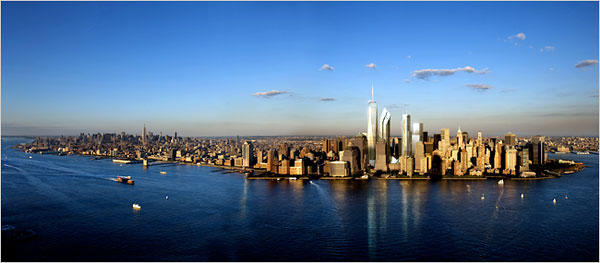
This morning, Silverstein released images of Towers 2, 3, and 4 at the Trade Center site... at first glance, I must confess a hesitant fondness for the slight dissonance of the three towers, as they relate to each other and to the massive Freedom Tower. Although I still question the rationale of providing (in addition to the Freedom Tower) three additional office buildings that each approach (or reach, in Foster's case) the size of the Empire State Building, I do appreciate the heterogenuous quality of these latest images. The real problem for me, however, goes beyond form and has everything to do with program. The bottom line is that Lower Manhattan really doesn't need such a smorgasboard of new office space. Ask any New Yorker and they'll concur: the city needs housing. Until issues of affordable housing are put on the table, and until the city and state manage to pressure Silverstein & Co. to address some sort of social agenda (beyond the trite reliance on jingoistic iconography), no superstar architect, however skillful or progressive, will be able to make a positive impact.

link: "Designs Unveiled for Freedom Tower's Neighbors" by David Dunlap, in the Times

06 September 2006

blog radar :: 6 september

A quick post to mention two noteworthy blogs that I recently came across:

  • Exquisite Struggle , Andrew Faulkner's periodic ruminations and "reflections and Radical Critique on Architecture, Urbanism, Philosophy, and Daily Life." What hooked me was today's post on Paris Hilton. A must-read.
  • Tenuous Resilience, an endeavor by Evan Chakroff, an architecture student at Ohio State. The latest post is a thoughtful reflection on building codes and other architectural (and non-architectural) manifestations of the "illusion of safety." As Chakroff laments such illusions for limiting the thrill and dynamism produced by the threat of danger, he touches on (but never actually mentions) an age-old architectural preoccupation: the sublime. What seems most provocative to me is how he links this notion of the supressed sublime to a larger political imperative -- and by doing so, shows quite clearly that the aesthetic experience (or its repressions) is always fundamentally political.
At first glance, these two bloggers both seem to promise plenty of polemical commentary and critique... I look forward to future provocations!


23 August 2006

SANAA in Toledo

[all images: six million dollar man's flickr site]

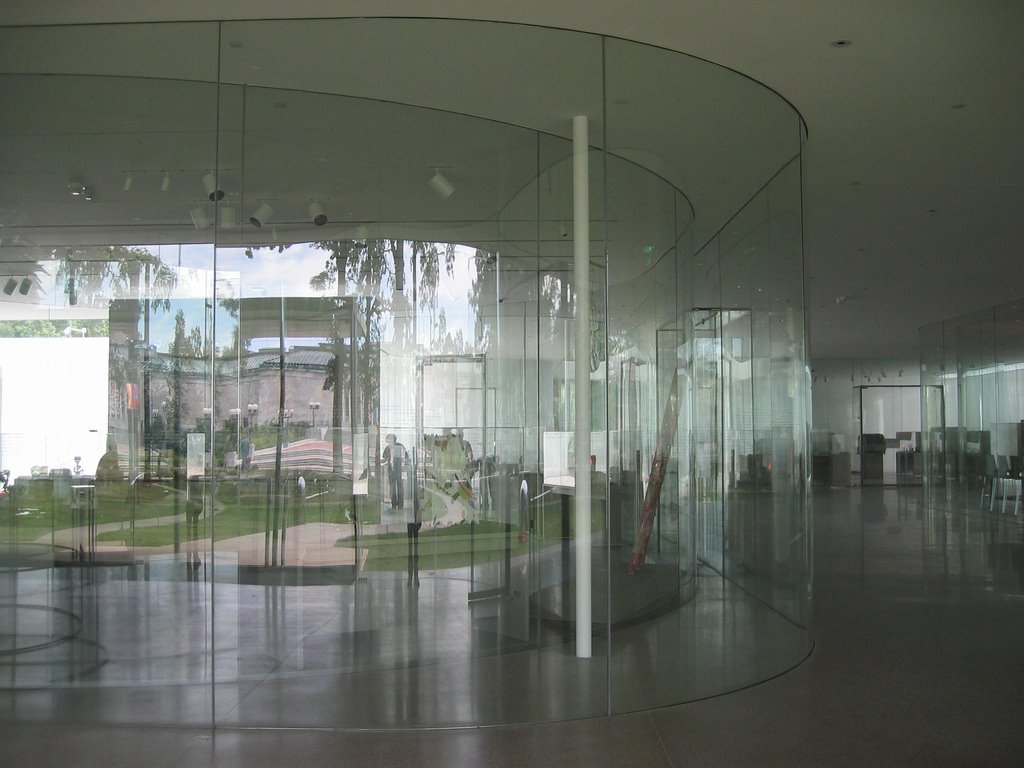
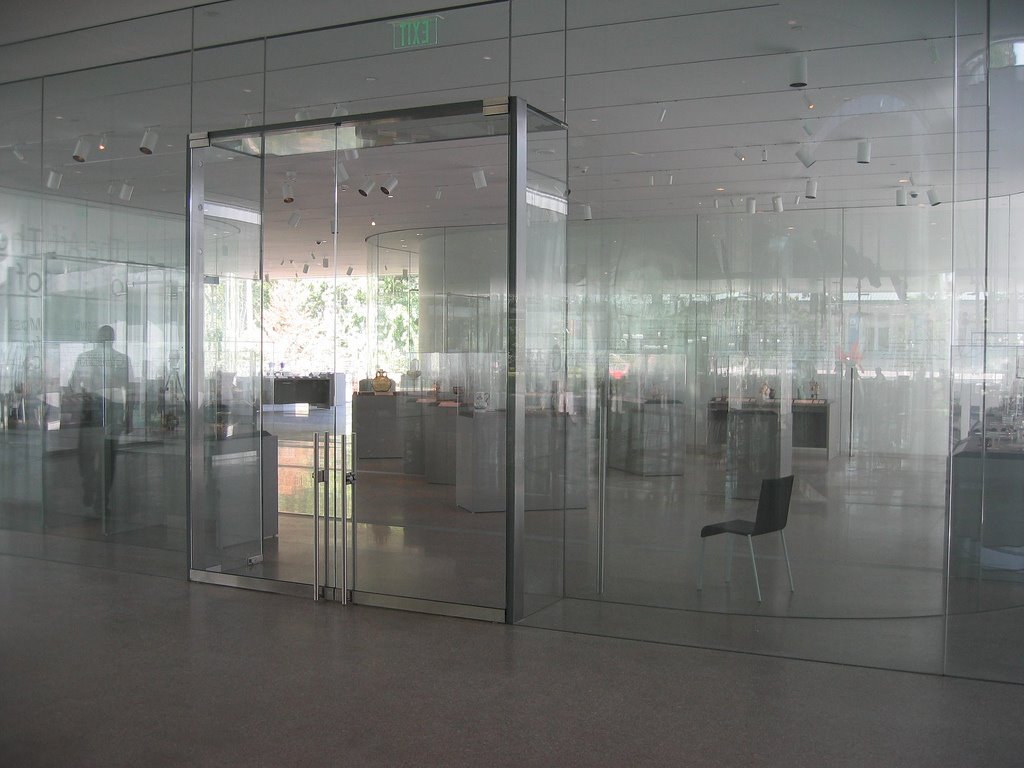
Check out Christopher Hawthorne's review of the brand new Glass Pavilion at the Toledo Museum of Arts, designed by Kazuyo Sejima and Ryue Nishizawa.

Their joint venture, SANAA, is known mostly for their highly refined, exquisitely detailed mastery of glass, which often produces other-wordly effects of transparency, layering, and pure visual fascination. I've never had the opportunity to see Sejima and Nishizawa's work in person -- although I eagerly await their forthcoming New Museum on the Bowery in New York -- but from what I can tell, there's something going on in their architecture that really distinguishes them from the rest of the contemporary field. I'm not really sure what it is yet. Something to do with an understated play with reflection, light, and visual relationships. But not in the modernist mode -- rather, SANAA operate with a completely postmodern sensibility. And I'm not talking about the disorienting, blingy, hall-of-mirrors postmodernism espoused by people like John Portman and theorized by people like Fredric Jameson, or the ridiculous Wallpaper magazine, empty neo-modernism that Hawthorne accurately criticizes. This work is much more hands-off and open to interpretation, and there is always much more to their projects than meets the eye. As you can tell, I'm having trouble verbalizing the appeal of their work -- as is Hawthorne, who suggests a contrast between SANAA's architecture and the bland minimalism that we find everywhere but, like me, fails to explain exactly why they're different. That's the point though. It's the irreducibility, the confusion, and the refusal of this work to be pigeonholed that makes it superb.

16 August 2006

"welcome to america"

For those who haven't heard this ridiculous story about this year's Senate race in Virginia, read this article. Apparently the esteemed incumbent, Senator George Allen, famous mostly for his father's role as a Washington Redskins coach, made a major racially-motivated gaffe at a campaign event over the weekend in a small town in southwestern Virginia (video here). The controversy comes from comments directed to S.R. Sidarth, a college-age volunteer for the campaign of Allen's Democratic opponent, Jim Webb, who is trailing the Allen campaign with a video camera to unobtrusively research the other side's speeches and strategies (a common campaign practice across the country). In the midst of a stump speech, directly after claiming that his campaign is "run on positive, constructive ideas," Allen began to address Sidarth, who happens to be a U.S.-born citizen of Indian descent, as "macaca," a derogatory term that he proceeded to repeat again -- indicating it was more than just a phonetic mispronunciation. Allen then followed up with "Welcome to America, to the real world of Virginia," implying falsely that both Sidarth and his candidate are strangers to nation and state. What most Virginians will (or should) realize is that this latest mishap follows Allen's long history of racial insensitivity, including episodes of Confederate flag worship and displaying a noose in his office. And regardless of any past offenses, this weekend's outburst reveals Allen to be an obnoxious bully (for lack of a better word), eager to single out the only non-white person in a political gathering and take advantage of that person's difference.
Now, if this were any normal election year, I would say who cares, he's going to win anyway, it's one of the reddest states in the union. But this isn't any typical year, and the Democrats are not running a typical candidate. Jim Webb is a former Republican, former Secretary of the Navy under President Reagan, and a conservative, pro-defense, anti-war alternative to the stale status quo of George Allen, who has done absolutely nothing over the last six years for either the state of Virginia, the country, or humanity. The race is still a long-shot at best for Webb, but perhaps this latest episode will mark the beginning of the end for Allen. The bloggers certainly won't let it die, and I think we've seen already in Connecticut that their political clout is not to be underestimated. Who knows. This is all to say (in too many words, as usual) that if you live in Virginia, you should not only vote for Jim Webb, but you should help his campaign in any way possible. And if you don't live in Virginia, check out his site anyway, and maybe you can help too. Maybe then, come November 7, we can all welcome George Allen to "the real world of Virginia" on his way out of DC and into retirement.


"he has always been better at rhetoric than architecture"

Following up on an earlier post: Christopher Hawthorne reviews Eisenman's new stadium for the Arizona Cardinals.
link: "Grass isn't greener" in the L.A. Times

14 August 2006

blog radar :: 14 august

Just catching up the highlights of my Google Reader feeds these past few weeks:

  • BLDGBLOG. Geoff Manaugh has kept up a constant stream of noteworthy posts, including the Kazys Varnelis interview noted previously, speculation on "landscape theology" (whatever that is) in an interview with Erik Davis, and a feature on inflatable/biodegradable toilets for refugee camps by Studio Cycle.
  • Subtopia. Another blog with consistently high-quality posts, ranging from border station design ( "Welcome to America") to refugee urbanism in Israel and Lebanon ("War as Vacation" ) to a review of an exhibition on the city of Tijuana ("Strange New World" ). The recurring theme of border urbanism reminds me of an article in the most recent issue of Log (#7) by Marie Aquilino ("Free Zone: A Conversation with Amos Gitai"), which addresses Gitai's film "Free Zone" and the the strange phenomena of free-trade cities, particularly Zarqa City in Jordan, a hub with links to the borders with Iraq, Syria, and Saudi Arabia.
  • The fallacy of New Urbanism. From Planetizen, Leonardo Vazquez has written an article ("Urban Fables: The Role Of Storytelling And Imagery In Successful Planning Movements") on how the New Urbanist movement has ap propriated religious strategies of allegory and myth to further their cause. Vazquez compares the New Urbanists to the conservative property rights movement (in terms of their similar appeals to " people's hopes, fears and beliefs") -- while this is certainly right on the mark, I would go further and say that New Urbanism not only takes hints from property rights activists, but in fact operates in an almost identitcal manner as the broader political and religious right wing. Readers of this blog have heard me rant previously on the convergence of New Urbanist and conservative political ambitions in the wake of Hurricane Katrina. I must say that there is a certain satisfaction in seeing other writers not only comment on the ultimate fiction of New Urbanism -- its false nostalgia for a past that never existed in the first place, as I like to say -- but also relate it to the fictions (and, dare I say, untruths) that underlie the contemporary right-wing agenda in this country.
  • Niemeyer still going strong. From Tropolism, some cool photos of Oscar Niemeyer's latest project, a theater in Ibirapuera Park, São Paulo. Looks like the old guy still has it...
  • Keller Easterling talks. An Archinect feature: Mason White interviews architect, theorist, and Yale professor Keller Easterling about her writings and practice. From having seeing Easterling's lectures and having her on a couple reviews while at school, I've always been intrigued by her fascination with such strange things as third-world golf courses, cruise ships, and industrial tomato farms. I've been meaning for a while to check out her latest book Enduring Innocence -- check out the interview for a taste.
  • Why Sylvia Sucks. From Michielangelo, a humorous yet enchantingly critical review of a lecture by Sylvia Lavin. I won't go into the details, but topics include iconography, dildos, and pet rocks. Worth checking out.

bldgblog: interview with kazys varnelis

BLDGBLOG continues its recent string of fantastic posts with Geoff Manaugh's interview with Kazys Varnelis, of AUDC and the newly formed Network Architecture Lab at Columbia's GSAPP. Check it out. I was lucky enough to see Varnelis's talk at the Philip Johnson symposium in Yale back in February, which reframed Johnson's career as a series of powerful social and professional networks, and which used Johnson's AT&T Building project from the 80s as a narrative framework for the critique (read the paper here). Varnelis's new position at the GSAPP represents one of Mark Wigley's first new major hires for the history/theory curriculum since his accession to the deanship two years ago, and I think it's definitely a smart pick-up for the school... Varnelis will join the likes of Frampton, McLeod, Ockman, and Reinhold Martin -- already quite a strong bunch -- and hopefully his addition to the faculty represents a renewed commitment to the critical approach espoused by these folks over the years. If nothing else, the NetLab is evidence of Wigley's ever-so-slight shift away from the digital form-obsessed Tschumi years towards a more politically, socially, and ethically conscious form of architectural education. Can't wait to see how it all plays out...

link: "The Logistics of Distance: An Interview with Kazys Varnelis", at BLDGBLOG

10 August 2006

"dynamism tamed"


Ouroussoff's review in today's Times of Peter Eisenman's new Cardinals stadium misses the point by focussing primarily on the architect's compromise between formal innovation and pragmatic realities. First of all, it's a fallacy to give Peter Eisenman any recognition for reinventing the stadium typology, as Ouruossoff seems to do. A football stadium is a football stadium, and this one seems no different. Sure, the motorized field that slides outside the air-conditioned stadium for sunlight and rain is pretty cool and innovative, and it could even be spun as some sort of contemporary, mega-futuristic folly (although one that reflects poorly on our culture's environmental and land-use priorities). But there is no attempt on Eisenman's part to question stadium convention in any formal or programmatic way. An earlier scheme included a somewhat more interesting attempt to integrate the facade slots into the landscape, but apparently that quietly fell prey to value engineering. The final product clearly demonstrates Eisenman's true role of providing the fancy metal icing for your standard wedding cake football stadium. Indeed, the design team of Eisenman Architects and HOK Sport seems to me less a partnership and more a division of labor: Eisenman does the outside skin, and HOK takes care of everything else.

Not that there's anything wrong with that. Don't get me wrong - when I say that Nicolai is missing the point, I mean that he fails to grasp what Eisenman is really up to down in Arizona. A lifetime football nut, Eisenman is clearly having fun, designing a container for his favorite sport. The opportunity to design your own football stadium doesn't come around that often. I've heard this sentiment from the man himself at several lectures and presentations, and at 73, after a long combative career of pissing off people, wouldn't you want to kick back and work on something fun for a change?

So forget the lesson on value engineering, Nicolai. It's a stadium. A nice stadium, but a stadium nonetheless.

link: "Dynamism Tamed by Cost-Cutters" by Nicolai Ouroussoff, in the New York Times

07 August 2006

on lamont vs. lieberman

Since the Connecticut Democratic primary is only two days away, I thought I'd put in my two sense on the race between Senator Joe Lieberman and his challenger in the primary, Greenwich businessman Ned Lamont. The netroots left of course has come out strongly in support of Lamont, less for his actual merits and more for the simple fact that he is not Lieberman, and not in support of our occupation of Iraq. While many heralded the demise of the lefty blogosphere in the wake of Dean's 2004 loss in Iowa, it seems that the rumors of such a death have been greatly exaggerated. Indeed, in a remarkable turn of events over the past month or so, Lamont's campaign, supported vigorously by bloggers and online fundraisers galore, has surged beyond all expectations, with the latest polls showing the challenger with a strong lead. My fascination (and the national media's, I presume) with this particular race stems not so much from an interest in Connecticut state politics, or even for the race's ultimate effect on the composition of the next Senate. Rather, I think (and hope) that this race will have huge consequences for the overall Democratic efforts leading up to November to take back control of the House and Senate. The unexpected rise of an unknown primary challenger and the apparent collapse of one of the Democratic Party's most established and long-serving members of Congress, while having nothing to do with the typical architectural banter that typically graces these pages, has everything to do with the notion of a "progressive reaction." It's ironic that the netroots advocacy of Lamont has coopted the time-tested Republican tactic of emphasizing a single issue -- in this case, the war in Iraq -- and making the entire election a referendum on that particular cause. It's a progressive, anti-war movement operating in a reactionary manner. Will it work for Lamont and his agitated supporters? Who knows. And even if it does, will such a strategy work in the general Congressional elections on November 7? A fired-up Democractic left means one thing during primary season, but it's a whole different ballgame once you factor in the red half of America, especially in states like Missouri, Arizona, Montana, and Virgina, all states with crucial races this fall. Again -- who knows.

All bets are off for Tuesday's race: I certainly would not underestimate Joe Lieberman's organization, election day GOTV efforts, and his capacity to come back from behind. Not to mention his potential candidacy as an Independent, which would be difficult for Lamont to overcome in November. But if I were a resident of the great state of Connecticut, would I take a risk, reject a more or less decent Senator who has spent his whole political career advocating causes with which I identify, and rashly embrace some no-name millionaire who has offered nothing coherent save for a staunch opposition to our military presence in Iraq? You bet I would. Enough is enough: it's time for the Democratic Party to realize that it not only has the potential to regain the majority, but that it already represents the majority. Most Americans want to fix the mess in Iraq; all they need is someone to offer them a way out and a valid alternative to the horrid status quo that reigns in Washington. It's time.

05 August 2006

more on sam jacob + VSBA

Following up on an earlier post: I just came across another piece by Sam Jacob (of England's FAT), which somehow I missed during previous visits to his fantastic site. As I've written about previously, Jacob again embraces Venturi and Scott Brown, he suggesting an atypical (yet nonetheless insightful) interpretation of their career. Although he confesses a fondness for their built work (including the Acadia Summer Arts Program, pictured above), the true root of his admiration (and mine, for that matter) seems to be on a larger ideological and polemical level. It becomes less about that problematic label of "postmodernism" and more about a deeper modus operandi of "Pop": not the standard definition of Pop that we all learned about in Art History class, but rather (in Jacobs' words) "a kind of socially engaged Pop -- a Pop that isn't only fast, fun and ironic, but political and moral as well."

Why, you ask, does the progressive reactionary keep babbling on about Venturi, Scott Brown, and all their followers? Well, for one, it's all about the attitude. The mentality. For me, there's something inherently political -- both progressive and reactionary -- in the act of embracing what the establishment deems garish. Challenging the status quo of contemporary architecture, regardless of formal or stylistic preference, is always a positive thing. Or maybe my affinity for the work of VSBA and FAT stems from a more personal anxiety surrounding my own architecture and (in comparison) its muted blandness. Whatever the case: what it comes down to, and what Jacobs is so right about, is that we can all learn a lot from the ugly and the ordinary. After all, we're all postmodernists, and it's time we embraced it.