Showing posts with label venturi-scott-brown. Show all posts

14 September 2006

complexity and contradiction, revisited

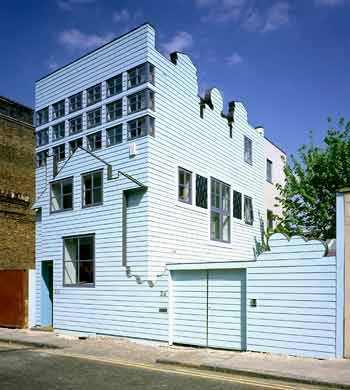
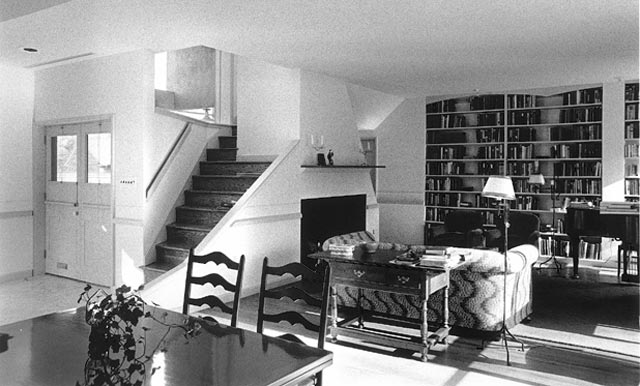
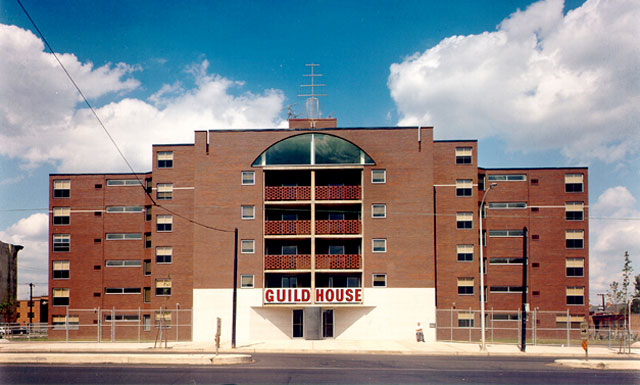
[all photos: Venturi Scott-Brown Associates]

I had a chance to swing by Columbia last night for a presentation by Bob Venturi, followed by a discussion between the architect and GSAPP dean Mark Wigley. You are probably rolling your eyes, since I seem to always have Venturi and his wife/partner Denise Scott-Brown on my mind. But indulge me once again -- there were some interesting moments worth sharing.

The event was loosely structured as a celebration of the 40-year anniversary of the publication of Venturi's seminal debut book, Complexity and Contradiction in Architecture (1966). For those who haven't read this -- you should. It is absolutely one of the most essential texts (along with Venturi's 1972 follow-up, Learning from Las Vegas, co-authored with Denise Scott-Brown and Steven Izenour) for understanding the predicaments facing contemporary architecture. After a stirring introduction by Lee Bollinger, Columbia's president and Venturi's old client back at Michigan, Venturi began with some brief reflections on both the book's inception and critical reception. Reiterating comments he has made over the years in various articles and symposia, he insisted that interpretations of the book or of him as being anti-modern or postmodern are completely misguided. This has always been pretty clear to me -- the book, while celebrating the immense stylistic diversity of historical architecture, by no means prescribes a specific style. Rather, it advocates an approach of celebratory, almost hedonistic, eclecticism -- or what Venturi likes to refer to as mannerism. While much of VSB's architectural production has involved neoclassical elements or historical references, the style itself is arbitrary and almost besides the point. [And furthermore, in line with Venturi's claim last night that Complexity and Contradiction ultimately affirmed a functionalist approach to architecture, almost all of the VSB work follows a strict functionalist paradigm of boxy, ultra-efficient floorplans that often divorce service spaces from served spaces. A reference to Kahn, no doubt, to whom Venturi also paid tribute tonight. The functionalist imperative appears again and plays a huge role in Learning from Las Vegas.] Anyway, the point is that it's understandable why historicist postmodern architects latched on to Complexity and Contradiction as justification for their stylistic carelessness, but the sweet irony is that, in true form, they completely missed the intricacy of Venturi's argument.

The discussion consisted mostly of Wigley's characteristic wizardry with words that seemed to completely baffle poor old Bob. He essentially asked the same question -- why did you write Complexity and Contradiction? -- a dozen times in a dozen different ways. The hope was to elicit some sort of polemical commitment to manifesto-writing and the activist potential of theorizing (to which I fully subscribe), but Venturi simply refused to cede Wigley any ground, insisting that the book grew out of his lectures for a theory class he was teaching at Princeton in the early 60's. I wondered if Wigley was actually talking less about Venturi and more about himself: if he was trying to posit a projective role for the writer in order to justify his own career as a non-practicing architect. Maybe that's getting a little too Wigley-psychoanalytic. Who knows. Anyway, the banter continued at length until Denise Scott-Brown, who, like the rest of us, could not take any more of the labyrinthine inquisition, finally decided to tell him what he wanted to hear. "Bob writes to figure out what he thinks," she said, explaining how the writing indeed came to inform their practice. Whether she was actually sincere, or whether she was just doing us all the favor of neutralizing the debate, I'll never know. But her brief words made me want more. Even though the event was nominally in honor of Complexity and Contradiction, which Venturi wrote solo, I realized (yet again) that Venturi without Scott-Brown is really only half the story.

The most interesting part of the evening was Venturi's emphatic characterization of his own writing as purely pragmatic and realist, as opposed to purely idealistic. In other words, he claims the basis of his learning and his analysis is always the existing conditions, the ordinary, the "real" world as it is, and that conclusions are never drawn from any preconceived ideologies. Hence the "Learning from..." technique that proved so crucial in the later collaboration with Scott-Brown and Izenour.

Clearly this enchantment with the messy realities, chaos, multiplicities, and vibrancies of everyday life is what really defines the Venturi Scott-Brown legacy. It certainly explains why I identify so strongly with their work. And seen in that light, it becomes evident why a school like Columbia would kick off its heavy-hitter lecture series with an event honoring good old Bob Venturi, who is still considered a postmodern pariah by many orthodox practitioners of architecture. It's definitely time, as architects as diverse as Koolhaas and FAT have come to realize, to reconsider the Venturis and their influence over the past forty years. Not only are they "back," as I've said - but maybe they never actually left.

05 August 2006

more on sam jacob + VSBA

Following up on an earlier post: I just came across another piece by Sam Jacob (of England's FAT), which somehow I missed during previous visits to his fantastic site. As I've written about previously, Jacob again embraces Venturi and Scott Brown, he suggesting an atypical (yet nonetheless insightful) interpretation of their career. Although he confesses a fondness for their built work (including the Acadia Summer Arts Program, pictured above), the true root of his admiration (and mine, for that matter) seems to be on a larger ideological and polemical level. It becomes less about that problematic label of "postmodernism" and more about a deeper modus operandi of "Pop": not the standard definition of Pop that we all learned about in Art History class, but rather (in Jacobs' words) "a kind of socially engaged Pop -- a Pop that isn't only fast, fun and ironic, but political and moral as well."

Why, you ask, does the progressive reactionary keep babbling on about Venturi, Scott Brown, and all their followers? Well, for one, it's all about the attitude. The mentality. For me, there's something inherently political -- both progressive and reactionary -- in the act of embracing what the establishment deems garish. Challenging the status quo of contemporary architecture, regardless of formal or stylistic preference, is always a positive thing. Or maybe my affinity for the work of VSBA and FAT stems from a more personal anxiety surrounding my own architecture and (in comparison) its muted blandness. Whatever the case: what it comes down to, and what Jacobs is so right about, is that we can all learn a lot from the ugly and the ordinary. After all, we're all postmodernists, and it's time we embraced it.

25 May 2006

jacob's tribute to vsb

More proof that the Venturis, about whom I've mused earlier, are indeed "back." Sam Jacob, about whom I've also mused earlier, has a sharp tribute on his blog to Venturi and Scott Brown, two of my heros in the world of contemporary architecture.

link: Topsy Turvy VSBA: Inverted Heros of an Upside Down Avant Guard

23 January 2006

FAT's postmodernism


I'VE BECOME FASCINATED LATELY with the work of the London office FAT (Fashion, Architecture, Taste), which recently has been commented upon here, here, and here. While at first glance, the architecture seems (at best) a weak update of earlier, perhaps more genuine attempts at architectural postmodernism, I think there may be something deeper going on here. After spending a short time on FAT's website (which, I'm sure not coincidentally, recalls that of Venturi Scott Brown), my initial disgust slowly is replaced by a more intellectual -- dare I say political? -- curiosity. Sure, it's easy to write these guys off (like I normally would) as typical anything-goes postmodernists, completely devoid of taste, ethics, conscience, or any other such redeeming quality. But this time I hesitate. Why?

It's simple: although on aesthetic grounds much of their work renders me mildly nauseous, FAT is nonetheless exonerated in my eyes by their relentless and engaging polemic. A refusal to accept the status quo -- in their case, the persistent dominance of English modernism as the benchmark for acceptable taste -- imbues FAT's project with something greater than mere "attitude." I identify with and commend the eagerness to reinvent architecture, how it is represented, and what is expected of it.

I also am intrigued (and even at times amused) by FAT's written polemic. Their website is full of mini-manifestos, many of which again bring to mind the legacy of Venturi Scott Brown. "Maybe its time to decriminalise decoration and arrange an amnesty on ornament," FAT asks us in Everything Counts (In Large Amounts), a treatise on the evolution of architecture in the age of electronic communication.

FAT member Sam Jacob, in a piece on his own website Strange Harvest, caught my attention with a subtle yet definite elaboration on the central premise of Venturi + Scott Brown's 1972 masterpiece Learning from Las Vegas. Check it out:

The Pop Vernacular is a both a graveyard for the old and the superseded and the spawning ground of unexpected futures. A cornucopia of architectural salvage. The Pop Vernacular draws on all of time and space. And despite its familiarity, it glows with optimism and freshness. Far from the end of history, it is the well spring of the imminent future.
For those of you who don't remember your postmodernism, VSB begin their manifesto with the assertion that "Learning from the existing landscape is a way of being revolutionary for an architect." Yet I would argue that they never really followed through with proving Pop's revolutionary potential (at least in any political sense beyond the superficial and symbolic). Although VSB's embrace of the formal language of Pop was a valiant polemical move, especially at the time, their approach ultimately is misguided as it fails to offer a way out of the black hole of consumer capitalism. Call me crazy, but it seems like here, Mr. Jacob is suggesting a potentially progressive -- if still totally vague -- role for the Pop Vernacular. Is he hinting at an instrumentalization of Pop that maybe goes beyond that of Venturi and Scott Brown? Or will he end up at the same claustrophobic dead end of the windowless, decorated-shed interior of some casino on the Strip? Can't wait to see.

I'd be interested to see if anyone has any other links/commentary/criticism with regard to FAT and their work.

link: FAT
link: Sam Jacob's Strange Harvest
link: Hugh Pearman's FAT is a postmodernist issue: British pranksters get serious.

19 December 2005

venturi scott-brown love-fest

THIS MAY SOUND STRANGE and maybe hypocritical, but Robert Venturi and Denise Scott-Brown are my favorite contemporary architects. My admiration is not for their architecture--much of which I don't care for--but rather for the relentlessness of their attitudes and their insistence on maintaining some sort of polemical stance with respect to the status quo. Thoughts???

Check out Lynn Becker's recap of Venturi's recent talk at IIT in Chicago for some classic V-SB polemic.

[Another reason I love them: their website. It is by far the most amazing, schizophrenic, and perverse architecture website I have ever seen. Enjoy.]